


61 - 80 of 105 results
-
-
Rapport sur le Commerce Mondial 2014
More LessLe Rapport sur le commerce mondial 2014 examine comment quatre grandes tendances économiques récentes ont modifié la façon dont les pays en développement peuvent se servir du commerce pour favoriser leur développement. Ces tendances sont l'essor économique des pays en développement, l'intégration croissante de la production mondiale à travers les chaînes d'approvisionnement, la hausse des prix des produits agricoles et des ressources naturelles, et la plus grande interdépendance de l'économie mondiale. Le Rapport examine aussi le rôle de l'OMC.
-
-
-
Rapport sur le Commerce Mondial 2015
More LessL’Accord de l’OMC sur la facilitation des échanges (AFE), approuvé par les Membres de l’OMC à la Conférence ministérielle de Bali en décembre 2013, est le premier accord commercial multilatéral conclu depuis la création de l’OMC en 1995. Le Rapport sur le commerce mondial 2015 est la première étude détaillée sur les effets potentiels de l’AFE fondée sur une analyse complète du texte final de l’Accord.
-
-
-
Rapport sur le Commerce Mondial 2016
More LessLe Rapport sur le commerce mondial 2016 examine la participation des petites et moyennes entreprises (PME) au commerce mondial, l’évolution du paysage commercial international pour les PME et ce que le système commercial multilatéral fait et peut faire pour encourager la participation plus large et inclusive des PME aux marchés mondiaux.
-
-
-
Rapport sur le Commerce Mondial 2017
More LessLe Rapport sur le commerce mondial 2017 examine comment la technologie et le commerce influent sur l'emploi et les salaires. Il analyse les difficultés que rencontrent les travailleurs et les entreprises pour s'adapter à l'évolution du marché du travail et la façon dont les gouvernements peuvent faciliter cet ajustement pour faire en sorte que le commerce et la technologie soient inclusifs.
-
-
-
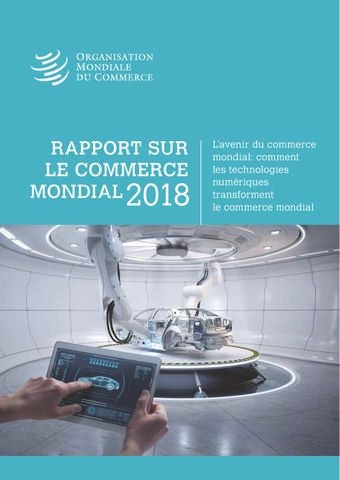
Rapport sur le Commerce Mondial 2018
More LessLe monde change à une incroyable vitesse et ce sous l’influence de nombreux facteurs, y compris l’évolution des modes de production et de consommation, l’innovation technologique permanente, les nouvelles façons de faire du commerce et, bien sûr, la politique. Le Rapport sur le commerce mondial 2013 montre en quoi le commerce est à la fois une cause et un effet du changement et examine les facteurs qui façonnent l’avenir du commerce mondial.
-
-
-
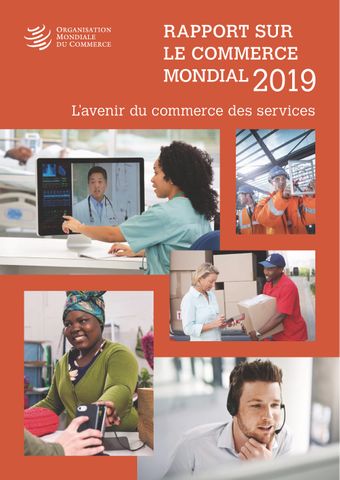
Rapport sur le commerce mondial 2019
More LessLes services sont devenus la composante la plus dynamique du commerce mondial et jouent un rôle de plus en plus important dans l’économie mondiale et dans la vie quotidienne. Pourtant, l’importance de la contribution des services au commerce mondial n’est pas toujours bien comprise. Le Rapport sur le commerce mondial 2019 tente d’y remédier en utilisant un nouvel ensemble de données élaboré par l’OMC qui prend en compte les différentes façons dont les services sont fournis à travers les frontières. Le Rapport examine la manière dont le commerce des services a évolué ces dernières années et se penche sur la question de savoir pourquoi le commerce des services compte. Les grandes tendances qui influent sur le commerce des services, y compris l’évolution démographique, les technologies numériques, la hausse des revenus et le changement climatique, sont examinées. Le Rapport donne aussi des estimations concernant l’évolution possible du commerce des services au cours des 20 prochaines années et les perspectives en matière de renforcement de la coopération internationale dans le domaine des politiques relatives au commerce des services. Le Rapport constate que les coûts du commerce des services sont plus élevés que ceux du commerce des marchandises mais qu’ils diminuent, en grande partie sous l’effet des technologies numériques. Il montre en quoi la baisse des coûts du commerce devrait accroître la part des services dans le commerce mondial et en quoi cela pourrait contribuer à une croissance et un développement plus inclusifs. Pour que les économies puissent tirer parti du rôle croissant joué par le commerce des services, la coopération internationale devra s’intensifier.
-
-
-

Rapport sur le commerce mondial 2020
More LessÀ l’ère numérique, les états sont de plus en plus nombreux à adopter des politiques visant à stimuler la croissance par l’innovation et la modernisation technologique. Le Rapport sur le commerce mondial 2020 présente ces tendances et examine comment le commerce et l’OMC s’y adaptent. Le soutien à la transition vers une économie numérique a caractérisé les politiques publiques adoptées ces dernières années. Le commerce et les politiques commerciales ont toujours été des moteurs importants pour l’innovation. En particulier, le système commercial multilatéral a largement contribué à la diffusion planétaire de l’innovation et des technologies en favorisant la prévisibilité des conditions du marché mondial et en soutenant le développement des chaînes de valeur mondiales. À mesure que les données deviennent un intrant essentiel dans l’économie numérique, les entreprises s’appuient davantage sur des actifs incorporels que sur des actifs physiques et les entreprises numériques peuvent accéder plus rapidement aux marchés mondiaux sans devoir consentir aux importants investissements matériels qui étaient auparavant nécessaires dans d’autres secteurs. Dans le contexte de l’économie numérique, le succès dépendra de l’ouverture, de l’accès aux biens et services liés aux technologies de l’information et de la communication (TIC), de la collaboration dans les projets de recherche et de la diffusion des connaissances et des nouvelles technologies. Le Rapport sur le commerce mondial 2020 montre que la coopération internationale a un rôle important à jouer pour rendre plus efficace la poursuite du développement numérique et de l’innovation technologique, tout en réduisant au minimum les retombées négatives des politiques nationales. Conclus il y a un quart de siècle, les Accords de l’OMC se sont révélés remarquablement avancés en mettant en place un cadre favorable au développement des économies reposant sur les TIC, quel que soit leur niveau de développement. La poursuite de la coopération internationale, à l’OMC et dans d’autres instances, permettrait de poursuivre l’innovation et de réduire les tensions commerciales pour contribuer à rendre plus prévisible le fonctionnement des marchés internationaux.
-
-
-
Regional Rules on the Global Trading System
More LessThe proliferation of regional trade agreements (RTAs) over the past two decades has highlighted the need to look closely at the potential conflicts between regional and WTO rules or disciplines. A major obstacle to advancing understanding of RTAs is the absence of detailed information about their contents. This has limited the debate between those who view RTAs as discriminatory instruments hostage to protectionist interests and those who see them as conducive to multilateral trade opening. This book provides detailed analysis of RTA rules in six key areas - market access, technical barriers to trade, contingent protection, investment, services and competition policy - across dozens of the main RTAs in the world. The analysis helps to provide new insights into the interplay between regional and multilateral trade rules, advances understanding of the economic effects of RTAs and contributes to the discussion on how to deal with the burgeoning number of RTAs.
-
-
-
Regional Trade Agreements and the Multilateral Trading System
More LessThis volume contains a collection of studies examining trade-related issues negotiated in regional trade agreements (RTAs) and how RTAs are related to the WTO's rules. While previous work has focused on subsets of RTAs, these studies are based on what is probably the largest dataset used to date, and highlight key issues that have been negotiated in all RTAs notified to the General Agreement on Tariffs and Trade (GATT) and the World Trade Organization (WTO). New rules within RTAs are compared to rules agreed upon by WTO members. The extent of their divergences and the potential implications for parties to RTAs, as well as for WTO members that are not parties to RTAs, are examined. This volume makes an important contribution to the current debate on the role of the WTO in regulating international trade and how WTO rules relate to new rules being developed by RTAs.
-
-
-
Report on G20 Trade Measures
More LessThe WTO’s 21st Monitoring Report on G20 trade measures issued on 24 June shows that the trade coverage of new import-restrictive measures introduced during the period (October 2018 to May 2019) was more than 3.5 times the average since May 2012 when the report started including trade coverage figures. The report found that trade coverage of USD 335.9 billion during the period is the second highest figure on record, after the USD 480.9 billion reported in the previous period. Together, these two periods represent a dramatic spike in the trade coverage of import-restrictive measures, leading WTO Director-General Roberto Azevêdo to call on G20 economies to work together urgently to ease trade tensions.
-
-
-
Report on G20 Trade Measures (2010)
More LessG20 governments continue to resist protectionist pressures but risks remain: A joint report by the WTO, OECD and UNCTAD released on 4 November 2010 for the Group of 20 biggest economies, ahead of their meeting in Seoul on 11 November, says that by and large, G20 governments have continued to resist protectionist pressures. But it also warns of potential dangers in the months ahead because of persistent high levels of unemployment and tensions over foreign exchange rates.
-
-
-
Report on G20 Trade Measures (2011)
More LessProtectionist pressures on the rise, latest G20 monitoring report says: G20 governments have introduced more trade barriers, including export restrictions, in the past six months than in previous periods since the financial crisis began, according to the monitoring report by the World Trade Organization, the Organisation for Economic Co-operation and Development and the UN Conference on Trade and Development released on 24 May 2011. Although measures to lower trade barriers are also accelerating, new import restrictive measures taken by G20 economies over the period October 2010 to April 2011 cover around 0.6% of total G20 imports which is also an increase over the previous six months (0.3%). Export restrictions are also on the rise. This adds to the cumulative total of world trade affected by new restrictions since the crisis began. Despite the positive forecasts for 2011, the outlook for world trade remains clouded by a number of significant risk factors in addition to the recent natural disasters in Japan. Sovereign debt problems, rising prices for food and other primary commodities, and unrest in major oil exporting countries generate uncertainties for the near future.
-
-
-
Report on G20 Trade Measures (2011)
More LessWTO G-20 report: Weak growth and imbalances “testing” government resolve against protectionism: The WTO’s report on G-20 trade measures, issued on 26 October 2011, said that “disappointingly weak growth in some G-20 countries and continuing macroeconomic imbalances globally are testing the political resolve of many governments to abide by the G-20 commitment to resist protectionism”. It said that “the situation is not yet alarming, but it is clearly adding to the downside risks to the global economy”.
-
-
-
Report on G20 Trade Measures (2012)
More LessLamy reports slowdown in G-20 trade restrictions but warns trade frictions on the rise: Director-General Pascal Lamy, in his report on G-20 trade measures issued on 31 October 2012, said that “there has been a slowdown in the imposition of new trade restrictive measures by G-20 economies over the past five months”. However, “at a time of continuous economic difficulties, trade frictions seem to be increasing”. He urged G-20 governments “to redouble their efforts to keep their markets open, and to advance trade opening as a way to counter slowing global economic growth”.
-
-
-
Report on G20 Trade Measures (2012)
More LessJoint study: restrictive measures continue apace, accrued restraints hit 3% of imports: The seventh WTO-OECD-UNCTAD report for the G-20 on trade and investment restrictions reveals that government-imposed trade and investment restrictions have not slowed and that the pace of removing such obstacles has decelerated. The accumulation of such restraints means that nearly 3% of global imports are affected while the restrictions now impact nearly 4% of G-20 trade.
-
-
-
Report on G20 Trade Measures (2013)
More LessG-20 trade restrictions increase as trade flows slow down, says WTO report: In the last six months, most G-20 members have put in place new trade restrictions or measures that have the potential to restrict trade, according to the latest WTO report on G-20 trade measures published on 18 December 2013. A total of 116 new trade restrictive measures were identified since the last WTO report, up from 109 measures recorded for the previous seven-month period.
-
-
-
Report on G20 Trade Measures (2013)
More LessWTO warns G-20 trade restrictions continue to accumulate as pace of removal remains slow: Director-General Pascal Lamy, in his report on G-20 trade measures issued on 17 June 2013, said that “more than 100 trade-restrictive measures were implemented by G-20 economies over the past seven months, covering around 0.5% of G-20 merchandise imports”. He called on the G-20 to “take positive steps to unlock the potential for trade to grow stronger by ensuring a successful outcome at the next Ministerial Conference in Bali”.
-
-
-
Report on G20 Trade Measures (2014)
More LessWTO report says restrictive trade measures continue to rise in G-20 economies: Restrictive trade measures introduced by G-20 economies since 2008 continue to rise, according to the latest WTO report on recent trade developments issued on 6 November 2014. Given the continuing uncertainties in the global economy, the report stresses the need for countries to show restraint in imposing new measures and to eliminate more of the existing measures.
-
-
-
Report on G20 Trade Measures (2014)
More LessAzevêdo reports trade restrictions down slightly, urges G-20 leadership on post-Bali agenda: The WTO’s report on G-20 trade measures, issued on 18 June 2014, said that “G-20 members put in place 112 new trade restrictive measures during the period mid November 2013 to mid-May 2014 — slightly down from the 116 new restrictive measures introduced in the previous period from mid-May to mid-November 2013”. Director-General Roberto Azevêdo said that “ it is clear that the coat of trade restrictions has grown a bit thicker over this period…this will not help our efforts to support growth and development around the world — and therefore we must remain watchful”.
-
-
-
Report on G20 Trade Measures (2015)
More LessWTO sees “slight deceleration” in G20 trade restrictions but calls for continued vigilance: The WTO’s thirteenth trade monitoring report on G20 trade measures, issued on 15 June, shows a slight deceleration in the application of new trade-restrictive measures by G20 economies, with the average number of such measures applied per month lower than at any time since 2013. The report also underlines that it is not yet clear that this deceleration will continue and it calls on G20 leaders to show continued vigilance and reinforced determination towards eliminating existing trade restrictions.
-