


851 - 894 of 894 results
-
-
World Tariff Profiles 2018
More LessWorld Tariff Profiles 2018 provides comprehensive information on the tariffs and non-tariff measures imposed by over 170 countries and customs territories. The publication starts with a breakdown of the tariffs imposed by these economies. Tariff data are presented in comparative tables and in one-page profiles for each economy. Statistics on non-tariff measures by country and by product group complement the data on tariffs. The publication also includes as a special topic an analysis of how least developed countries make use of preferential tariffs offered by trading partners for their export products. The publication is jointly prepared by the World Trade Organization, the United Nations Conference on Trade and Development (UNCTAD) and the International Trade Centre (ITC).
-
-
-
World Tariff Profiles 2019
More LessWorld Tariff Profiles 2019 provides comprehensive information on the tariffs and non-tariff measures imposed by over 170 countries and customs territories. It is a joint publication of the WTO, the International Trade Centre (ITC) and the United Nations Conference on Trade and Development (UNCTAD).
Tariff data are presented in comparative tables and in one-page profiles for each economy. Statistics on non-tariff measures by country and by product group complement the data on tariffs. The publication also includes as a special topic an analysis of how least-developed countries (LDCs) make use of preferential tariffs offered by trading partners for products exported by LDCs.
-
-
-
World Tariff Profiles 2020
More LessWorld Tariff Profiles 2020 provides comprehensive information on the tariffs and non-tariff measures imposed by over 170 countries and customs territories. The publication starts with a breakdown of the tariffs imposed by these economies. Tariff data are presented in comparative tables and in one-page profiles for each economy. A summary table on selected indicators on the imports and exports profile for these economies is also presented. Statistics on non-tariff measures by country and by product group complement the data on tariffs. The special topic is on market access for medical goods and COVID-19 medical supplies. The publication is jointly prepared by the World Trade Organization, the United Nations Conference on Trade and Development (UNCTAD) and the International Trade Centre (ITC).
-
-
-
World Tariff Profiles 2021
More LessWorld Tariff Profiles 2021 provides comprehensive information on the tariffs and non-tariff measures imposed by over 170 countries and customs territories. The publication starts with a breakdown of the tariffs imposed by these economies. Tariff data are presented in comparative tables and in one-page profiles for each economy. A summary table on selected indicators on the imports and exports profile for these economies is also presented. Statistics on non-tariff measures by country and by product group complement the data on tariffs. The special topic deals with estimating analytical indicators related to non-tariff measures using UNCTAD TRAINS data. The publication is jointly prepared by the World Trade Organization, the United Nations Conference on Trade and Development (UNCTAD) and the International Trade Centre (ITC).
-
-
-
World Trade Report 2003
More LessThe World Trade Report is a new annual WTO publication focused on trade trends and policy issues. The 2003 edition examines developments in South-South trade, trends in commodity markets, and the growth of Regional Trade Agreements.
-
-
-
World Trade Report 2004
More LessThe World Trade Report is an annual WTO publication focused on trade trends and policy issues. The 2004 edition reviews recent trade developments and examines issues including coherence in trade and macroeconomic policies, geographical indications, and the liberalization of trade in services through the temporary movement of natural persons.
-
-
-
World Trade Report 2005
More LessThe report focuses on specific trade policy issues of current interest and reviews trends in international trade. The core topic addressed in the 2005 Report is the relationship between standards and trade. The Report also contains 3 shorter essays on the use of quantitative economic analysis in WTO dispute settlement proceedings, trade in air transport services, and offshoring services.
-
-
-
World Trade Report 2006
More LessThe annual World Trade Report focuses on trade policy issues - the core topic addressed in 2006 is subsidies. The Report also takes a look at recent trade developments and examines a range of trade topics, including trade in textiles and clothing, flows of international receipts and payments of royalties and license fees, trends in the trade of least-developed countries, and the impact of natural disasters and terrorist acts on international trade flows. The World Trade Report is useful for policymakers and for any individuals or groups interested in global trade policy.
-
-
-
World Trade Report 2007
More LessOn 1 January 2008 the multilateral trading system will celebrate its sixtieth anniversary. The World Trade Report 2007 marks the occasion with a retrospective look at what we have learned from those six decades of international trade cooperation. In asking what we have learned, the report reviews a rich history of change and institutional adaptation. It attempts to identify both what lessons are to be drawn from past experience and the nature of challenges to come. The World Trade Report is useful for policymakers and for any individuals or groups interested in global trade policy.
-
-
-
World Trade Report 2008
More LessThe theme of this year’s Report is “Trade in a Globalizing World”. The Report provides a reminder of what we know about the gains from international trade and highlights the challenges arising from higher levels of integration. It addresses a range of interlinking questions, starting with a consideration of what constitutes globalization, what drives it, what benefits does it bring, what challenges does it pose and what role does trade play in this world of ever-growing inter-dependency. The Report asks why some countries have managed to take advantage of falling trade costs and greater policy-driven trading opportunities while others have remained largely outside international commercial relations. It also considers who the winners and losers are from trade and what complementary action is needed from policy-makers to secure the benefits of trade for society at large. In examining these complex and multi-faceted questions, the Report reviews both the theoretical gains from trade and empirical evidence that can help to answer these questions.
-
-
-
World Trade Report 2009
More LessOne of the main objectives of this Report is to analyze whether WTO provisions provide a balance between supplying governments with necessary flexibility to face difficult economic situations and adequately defining them in a way that limits their use for protectionist purposes. In analysing this question, the Report focuses primarily on contingency measures available to WTO members when importing and exporting goods. These measures include the use of safeguards, such as tariffs and quotas, in specified circumstances, anti-dumping duties on goods that are deemed to be “dumped”, and countervailing duties imposed to offset subsidies. The Report also discusses alternative policy options, including the renegotiation of tariff commitments, the use of export taxes, and increases in tariffs up to their legal maximum ceiling or binding. The analysis includes consideration of legal, economic and political economy factors that influence the use of these measures and their associated benefits and costs.
-
-
-
World Trade Report 2010
More LessThe World Trade Report 2010 focuses on trade in natural resources, such as fuels, forestry, mining and fisheries. The Report examines the characteristics of trade in natural resources, the policy choices available to governments and the role of international cooperation, particularly of the WTO, in the proper management of trade in this sector. A key question is to what extent countries gain from open trade in natural resources. Some of the issues examined in the Report include the role of trade in providing access to natural resources, the effects of international trade on the sustainability of natural resources, the environmental impact of resources trade, the so-called natural resources curse, and resource price volatility. The Report examines a range of key measures employed in natural resource sectors, such as export taxes, tariffs and subsidies, and provides information on their current use. It analyzes in detail the effects of these policy tools on an economy and on its trading partners. Finally, the Report provides an overview of how natural resources fit within the legal framework of the WTO and discusses other international agreements that regulate trade in natural resources. A number of challenges are addressed, including the regulation of export policy, the treatment of subsidies, trade facilitation, and the relationship between WTO rules and other international agreements.
-
-
-
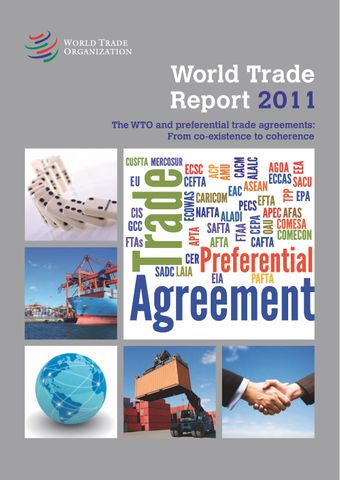
World Trade Report 2011
More LessThe ever-growing number of preferential trade agreements (PTAs) is a prominent feature of international trade. The World Trade Report 2011 describes the historical development of PTAs and the current landscape of agreements. It examines why PTAs are established, their economic effects, and the contents of the agreements themselves. Finally it considers the interaction between PTAs and the multilateral trading system. Accumulated trade opening - at the multilateral, regional and unilateral level - has reduced the scope for offering preferential tariffs under PTAs. As a result, only a small fraction of global merchandise trade receives preferences and preferential tariffs are becoming less important in PTAs. The report reveals that more and more PTAs are going beyond preferential tariffs, with numerous non-tariff areas of a regulatory nature being included in the agreements. Global production networks may be prompting the emergence of these "deep" PTAs as good governance on a range of regulatory areas is far more important to these networks than further reductions in already low tariffs. Econometric evidence and case studies support this link between production networks and deep PTAs.
-
-
-
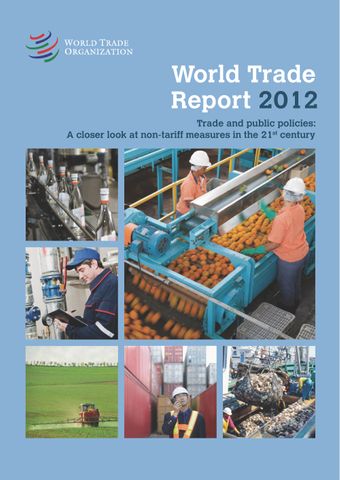
World Trade Report 2012
More LessRegulatory measures for trade in goods and services raise new and pressing challenges for international cooperation in the 21st century. The World Trade Report 2012 examines why governments use these non-tariff measures and to what extent such measures may distort international trade. Non-tariff measures (NTMs) can serve legitimate public policy goals, such as protecting the health of consumers, but they may also be used for protectionist purposes. The Report reveals how the expansion of global production chains, climate change and the growing importance of consumer concerns in richer countries affect the use of NTMs. It also reports that such measures represent the main source of concerns for exporters. The focus of the Report is on technical barriers to trade (TBT) regarding standards for manufactured goods, sanitary and phytosanitary (SPS) measures concerning food safety and animal/plant health, and domestic regulation in services. The Report looks at the availability of information on NTMs and the latest trends concerning usage. It discusses the impact that NTMs have on trade and examines how regulatory harmonization and/or mutual recognition of standards may help to reduce any trade-hindering effects. Finally, the Report looks at international cooperation on NTMs.
-
-
-
World Trade Report 2013
More LessThe world is changing with extraordinary rapidity, driven by many influences, including shifts in production and consumption patterns, continuing technological innovation, new ways of doing business and, of course, policy. The World Trade Report 2013 focuses on how trade is both a cause and an effect of change and looks into the factors shaping the future of world trade. One of the most significant drivers of change is technology. Not only have revolutions in transport and communications transformed our world but new developments, such as 3D printing, and the continuing spread of information technology will continue to do so. Trade and foreign direct investment, together with a greater geographical spread of income growth and opportunity, will integrate a growing number of countries into more extensive international exchange. Higher incomes and larger populations will put new strains on both renewable and non-renewable resources, calling for careful resource management. Environmental issues will also call for increasing attention.
-
-
-
World Trade Report 2014
More LessThe World Trade Report 2014 looks at how four recent major economic trends have changed how developing countries can use trade to facilitate development: the economic rise of developing economies, the growing integration of global production through supply chains, the higher prices for agricultural goods and natural resources, and the increasing interdependence of the world economy. It also looks into what role the WTO can play.
-
-
-
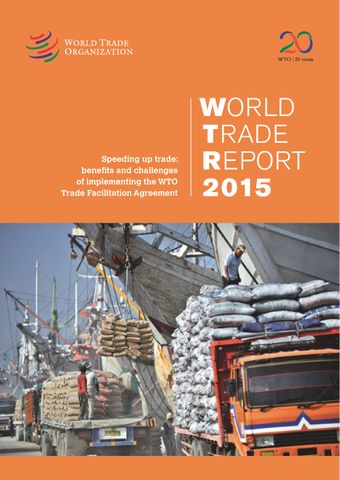
World Trade Report 2015
More LessThe World Trade Report 2015 examines why the Trade Facilitation Agreement is so important, what its economic impact is projected to be, and how the WTO is taking a number of important – and novel – steps to help countries to maximize its benefits.
-
-
-
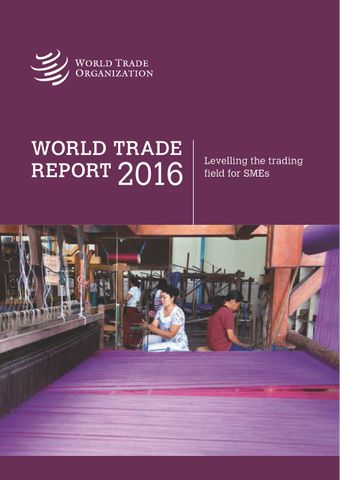
World Trade Report 2016
More LessThis report examines the participation of small and medium-sized enterprises (SMEs) in international trade, how the international trade landscape is changing for SMEs, and what the multilateral trading system does and can do to encourage more widespread and inclusive SME participation in global markets.
-
-
-
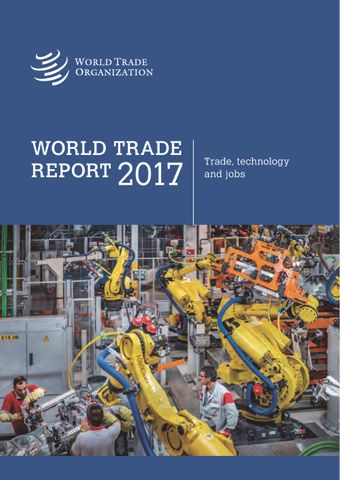
World Trade Report 2017
More LessThe 2017 World Trade Report examines how technology and trade affect employment and wages. It analyses the challenges for workers and firms in adjusting to changes in labour markets, and how governments can facilitate such adjustment to ensure that trade and technology are inclusive.
-
-
-
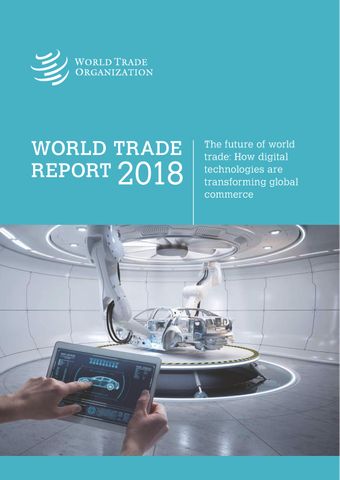
World Trade Report 2018
More LessTrade has always been shaped by technology but the rapid development of digital technologies in recent times has the potential to transform international trade profoundly in the years to come. The World Trade Report 2018 examines how digital technologies – and in particular the Internet of Things, artificial intelligence, 3D printing and Blockchain – affect trade costs, the nature of what is traded and the composition of trade. It estimates how global trade may be affected by these technologies over the next 15 years.
-
-
-
World Trade Report 2019
More LessServices have become the most dynamic component of global trade, with an increasingly important role in the global economy and in everyday life. Yet the extent of services’ contribution to global trade is not always fully understood. The World Trade Report 2019 attempts to remedy this by examining how trade in services is evolving and why services trade matters.
-
-
-
World Trade Report 2020
More LessIn the digital age, a growing number of governments have adopted policies aimed at boosting growth through innovation and technological upgrading. The World Trade Report 2020 looks at these trends and at how trade and the WTO fit with them. A defining feature of government policies adopted in recent years has been their support of the transition towards a digital economy. Trade and trade policies have historically been important engines for innovation. In particular, the multilateral trading system has contributed significantly to the global diffusion of innovation and technology by fostering predictable global market conditions and by underpinning the development of global value chains. As data become an essential input in the digital economy, firms rely more on intangible assets than on physical ones, and digital firms are able to reach global markets faster without the amount of physical investment previously necessary in other sectors. Success in the digital economy will depend on openness, access to information and communication technology (ICT) goods and services, collaboration on research projects, and the diffusion of knowledge and new technology. The World Trade Report 2020 shows that there is a significant role for international cooperation to make the pursuit of digital development and technological innovation more effective, while minimizing negative spill-overs from national policies. The WTO agreements, reached a quarter of a century ago, have proved to be remarkably forwardlooking in providing a framework that has favoured the development of ICT-enabled economies across all levels of development. Further international cooperation at the WTO and elsewhere would enable continued innovation and reduce trade tensions to help international markets function more predictably.
-
-
-
World Trade Statistical Review 2016
More LessThis new publication replaces the WTO’s annual flagship publication, "International Trade Statistics". "Statistical Review of International Trade 2016" provides a detailed analysis of the latest developments in world trade, focusing on the most recent trends in goods and services trade and the participation of developing economies in world trade. The publication also looks ahead to future developments. The analytical chapters are complemented by a statistical appendix containing over 60 tables providing detailed data on trade by region and sector. The publication serves as an invaluable reference tool for researchers, policy makers and anyone interested in international trade.
-
-
-
World Trade Statistical Review 2017
More LessWorld Trade Statistical Review looks into the latest developments in world trade, with a detailed analysis of the most recent trends for trade in goods and services. It also looks at the participation of developing economies in world trade and recent trade policy developments. The analytical chapters are complemented by a statistical appendix of over 60 tables providing comprehensive data on various facets of world trade in goods and services.
-
-
-
World Trade Statistical Review 2018
More Less“World Trade Statistical Review” looks into the latest trends in global trade, with in-depth analysis of what is being traded and who the key players are. It also reviews the latest developments in trade policy-making in areas such as trade facilitation and trade-restrictive measures. Analytical chapters are complemented by over 60 tables providing a detailed breakdown of the goods and services being traded and the leading exporters/importers.
-
-
-
World Trade Statistical Review 2019
More Less“World Trade Statistical Review” looks into the latest trends in global trade, with in-depth analysis of what is being traded and who the key players are. It also reviews the latest developments in trade policy-making in areas such as trade facilitation and trade-restrictive measures. Analytical chapters are complemented by over 60 tables providing a detailed breakdown of the goods and services being traded and the leading exporters/importers.
-
-
-
World Trade Statistical Review 2020
More Less“World Trade Statistical Review” looks into the latest trends in global trade, with in-depth analysis of what is being traded and who the key players are. It also reviews the latest developments in trade policy-making in areas such as trade facilitation and trade-restrictive measures. Analytical chapters are complemented by over 60 tables providing a detailed breakdown of the goods and services being traded and the leading exporters/importers.
-
-
-
World Trade Statistical Review 2021
More Less“World Trade Statistical Review” looks into the latest trends in global trade, with in-depth analysis of what is being traded and who the key players are. Analytical chapters are complemented by over 60 tables providing a detailed breakdown of the goods and services being traded and the leading exporters/importers.
-
-
-

WTO Accessions
More LessSince the WTO was established in 1995, 33 economies have joined the organization. This has resulted in over 20,000 pages of legal documents defining their specific terms of membership. These accessions have brought the WTO’s total membership to 161 economies, comprising more than 7 billion people and accounting for 98 per cent of world trade. This brochure, produced to mark the WTO’s 20th anniversary, looks into the WTO’s ever-expanding membership and the benefits of WTO accession.
-
-
-
WTO Accessions and Trade Multilateralism
More LessTrois questions importantes seront déterminantes pour l'avenir de l'OMC: le règlement des différends, les négociations et l'intégration régionale. Le règlement des différends est généralement considéré comme l'un des succès majeurs de l'OMC durant ses dix premières années d'existence. La conclusion des négociations du Cycle de Doha est l'un de ses principaux défis. L'intégration régionale est désormais au premier plan du débat alors que les accords régionaux prolifèrent et que les décideurs et les universitaires prennent la mesure de leur incidence sur le système commercial multilatéral. Ces questions, et leur interaction, sont traitées par d'éminents spécialistes et professionnels du droit commercial international originaires d'Amérique du Nord, d'Europe et de la région Asie Pacifique. En outre, des sections spécifiques sont consacrées à la région Asie Pacifique, à sa participation au règlement des différends et aux négociations dans le cadre de l'OMC, et aux tendances récentes à une plus grande intégration régionale.AE1:AE10
-
-
-
WTO Agreements & Public Health
More LessThis joint study by the World Health Organization and the World Trade Organization Secretariat on the relationship between trade rules and public health. The study explains how WTO Agreements relate to different aspects of health policies. It is meant to give a better insight into key issues for those who develop, communicate or debate policy issues related to trade and health. The study covers areas such as drugs and intellectual property rights, food safety, tobacco and many other issues which have been subject to passionate debate. In this joint effort, the first of its kind, WHO and the WTO Secretariat endeavour to set out the facts.
-
-
-
WTO Appellate Body Repertory of Reports and Awards, 1995–2013, 5th edition
More LessTrade multilateralism in the twenty-first-century century faces a serious test as weakness in the global economy and fast-paced technological changes create a challenging environment for world trade. This book examines how an updated and robust, rules-based multilateral framework, anchored in the WTO, remains indispensable to maximizing the benefits of global economic integration and to reviving world trade. By examining recent accessions to the WTO, it reveals how the growing membership of the WTO has helped to support domestic reforms and to strengthen the rules-based framework of the WTO. It argues that the new realities of the twenty-first century require an upgrade to the architecture of the multilateral trading system. By erecting its 'upper floors' on the foundation of existing trade rules, the WTO can continue to adapt to a fast-changing environment and to maximize the benefits brought about by its ever-expanding membership.
-
-
-
WTO Dispute Settlement
More LessOver the past 20 years, nearly 500 disputes have been brought to the WTO. About half of these were resolved during bilateral discussions while the other half proceeded to a panel process, which in recent years generally takes about 14 months. Appeals are considered by the WTO’s Appellate Body and – excluding exceptionally busy periods – are completed within three months. This makes the WTO’s dispute system one of the fastest in the world. This brochure, produced to mark the WTO’s 20th anniversary, looks into how the dispute settlement system operates.
-
-
-
WTO Dispute Settlement: One-Page Case Summaries 1995–2018
More LessWTO Dispute Settlement: One-Page Case Summaries provides a succinct summary of the key findings of every dispute panel report up to the end of 2018 and, where applicable, the subsequent Appellate Body report. Each one-page summary comprises three sections: the core facts; the key findings contained in the reports; and, where relevant, other matters of particular significance. The disputes are presented in chronological order (by dispute settlement number). Two indexes at the end of the publication list the disputes by WTO agreement and by WTO member responding to the complaint.
-
-
-
WTO Dispute Settlement: One-Page Case Summaries 1995–2020
More LessWTO Dispute Settlement: One-Page Case Summaries provides a succinct summary of the key findings of every dispute panel report up to the end of 2019 and, where applicable, the subsequent Appellate Body report. Each one-page summary comprises three sections: the core facts; the key findings contained in the reports; and, where relevant, other matters of particular significance. The disputes are presented in chronological order (by dispute settlement number). Two indexes at the end of the publication list the disputes by WTO agreement and by WTO member responding to the complaint.
-
-
-
WTO Dispute Settlement: One-Page Case Summaries, 1995-2012
More LessWTO Dispute Settlement: One-Page Case Summaries provides a succinct summary of the key findings of every dispute panel report up to the end of 2011 and, where applicable, the subsequent Appellate Body report. Each one-page summary comprises three sections: the core facts; the key findings contained in the reports; and, where relevant, other matters of particular significance. The disputes are presented in chronological order (by dispute settlement number). Two indexes at the end of the publication list the disputes by WTO agreement and by WTO member responding to the complaint.
-
-
-
WTO Dispute Settlement: One-Page Case Summaries, 1995-2016
More LessWTO Dispute Settlement: One-Page Case Summaries provides a succinct summary of the key findings of every dispute panel report up to the end of 2016 and, where applicable, the subsequent Appellate Body report. Each one-page summary comprises three sections: the core facts; the key findings contained in the reports; and, where relevant, other matters of particular significance. The disputes are presented in chronological order (by dispute settlement number). Two indexes at the end of the publication list the disputes by WTO agreement and by WTO member responding to the complaint.
-
-
-
WTO Dispute Settlement: One-Page Case Summaries, 1995–2014
More LessWTO Dispute Settlement: One-Page Case Summaries provides a succinct summary of the key findings of every dispute panel report up to the end of 2014 and, where applicable, the subsequent Appellate Body report. Each one-page summary comprises three sections: the core facts; the key findings contained in the reports; and, where relevant, other matters of particular significance. The disputes are presented in chronological order (by dispute settlement number). Two indexes at the end of the publication list the disputes by WTO agreement and by WTO member responding to the complaint.
-
-
-
WTO Domestic Regulation and Services Trade
More LessDomestic regulation of services sectors has a significant impact on services trade liberalization, which is why General Agreement on Trade in Services (GATS) disciplines are negotiated in the WTO. With the help of analyses and case-studies from academics, regulators and trade experts, this book explores the scope and limits of WTO legal principles to promote domestic regulatory reform. Case-studies discuss country-specific challenges and experiences of regulating important service sectors, such as finance, telecommunications, distribution, legal, education, health, postal and logistics services, as well as the role of regulatory impact assessments. The findings will interest trade officials, policy-makers, regulators, think tanks and businesses concerned with the implications of domestic regulation on access to services markets, and with the opportunities for formulating trade disciplines in this area. It is also a useful resource for academics and students researching regulatory approaches and practices in services sectors.
-
-
-
WTO in Brief
More LessIn brief, the World Trade Organization (WTO) is the only international organization dealing with the global rules of trade. Its main function is to ensure that trade flows as smoothly, predictably and freely as possible.
-
-
-
WTO Ministerial Conferences
More LessKey outcomes from WTO Ministerial Conferences since the organization was established in 1995.
-
-
-
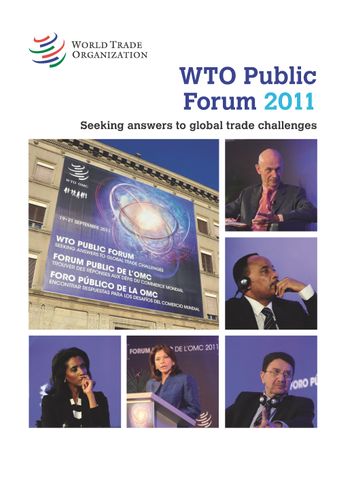
WTO Public Forum 2011
More LessThe sessions held during the 2011 Public Forum triggered a frank and open debate on the principal global challenges for the multilateral trading system. The Forum also sought to identify practical and effective solutions and ways forward to enable the WTO to adapt and respond effectively to our fast-changing world. A chapter is devoted to each of the sessions held during the three-day programme.
-
-
-
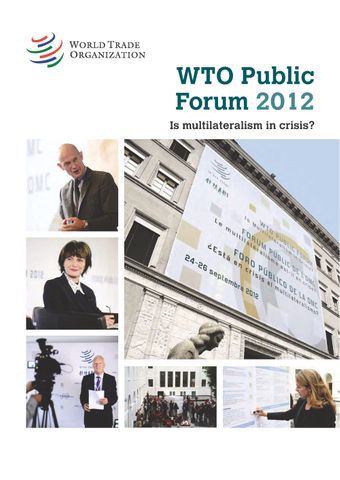
WTO Public Forum 2012
More LessThe 2012 WTO Public Forum posed the question: “Is multilateralism in crisis?”, providing an opportunity for participants from a variety of backgrounds to discuss this question across the three-day event. The themes of the Forum included formulating new approaches to multilateral trade opening in areas such as trade facilitation, addressing 21st-century issues and identifying areas in need of new regulations, and examining the role of non-state actors in strengthening the multilateral trading system. This publication contains summaries of all of the sessions held and reports on the results of the WTO Youth Ambassador Programme and Ideas Workshops.
-
-
-
¿Pueden las cadenas de bloques revolucionar el comercio internacional?
More LessEl progreso tecnológico siempre ha condicionado el comercio. En los últimos años, muchos observadores han saludado la aparición de una nueva tecnología, las cadenas de bloques, como el nuevo factor que transformará de manera radical el panorama comercial. ¿Pueden las cadenas de bloques revolucionar el comercio internacional? El objetivo de la presente publicación es desmitificar el fenómeno de las cadenas de bloques aportando una explicación básica de esta tecnología. En el documento se analiza la importancia que tiene esta tecnología para el comercio internacional, indicando cómo se utiliza en la actualidad y cómo podría llegar a utilizarse en diversas esferas abarcadas por las normas de la OMC. Del análisis se desprende en qué medida podría la adopción de esta tecnología afectar al comercio transfronterizo de mercancías y servicios y a los derechos de propiedad intelectual. El documento examina las posibilidades que ofrecen las cadenas de bloques para reducir los costes del comercio y mejorar la transparencia en las cadenas de suministro, así como las oportunidades que brinda a los pequeños productores y las pequeñas empresas. Por último, el documento repasa los distintos retos que es necesario superar para que la tecnología pueda utilizarse a gran escala e incidir de manera significativa en el comercio internacional.
-